DevArch Engineering Harness
The harness
Plan
Session-sized phases, checked against the decisions you already made.
Deliver
Gated sessions, behavior-tested commits, decisions recorded.
Carry forward
Summaries, ADRs, and open items the next session reads first.
One record runs through all three: plain files in git, enforced by hooks.
Directives, agents, and skills that enforce engineering discipline at every step: session continuity, quality gates, behavioral tests, and ADRs, all automatic. While the code is written, DevArch's gates and agents enforce the discipline that keeps quality compounding: behavior is tested, boundaries hold, and decisions are written down where the next session will find them.
14-day free trial · $99/yr after · no charge today
Why DevArch
An architect in the room.
AI makes a lone developer fast. DevArch makes them disciplined: the expert presence that keeps architecture coherent and quality compounding, so a small team delivers like a big one.

Hold the boundaries
Architecture shouldn't live in one person's head. DevArch holds the line as the code grows: Boundary Statements gate edits to cross-boundary state, dependencies flow inward, and every decision that constrains future work lands in an ADR instead of evaporating at the end of a session.

From BUILD: FAILED to all green
Behavioral tests, mutation checks, and quality gates turn a red build into a passing one, with the tests that prove it. You direct the work; DevArch keeps the discipline, so quality compounds instead of eroding.
How it works
The discipline is automatic.
DevArch hooks into Claude Code's lifecycle. Every session follows this discipline without you invoking it, and nothing is lost between sessions.
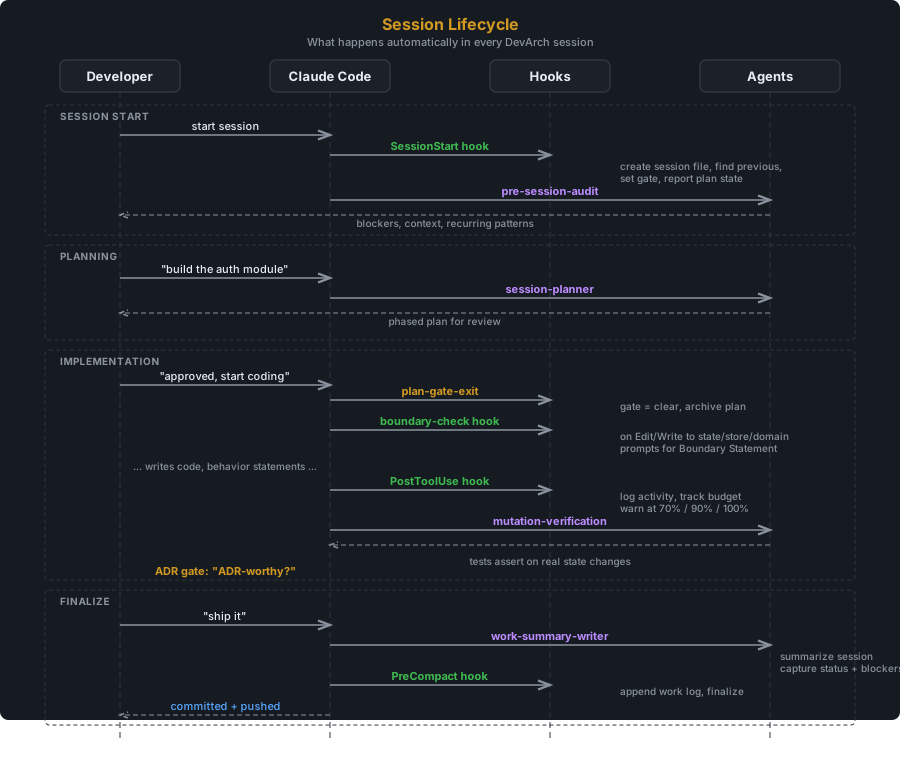
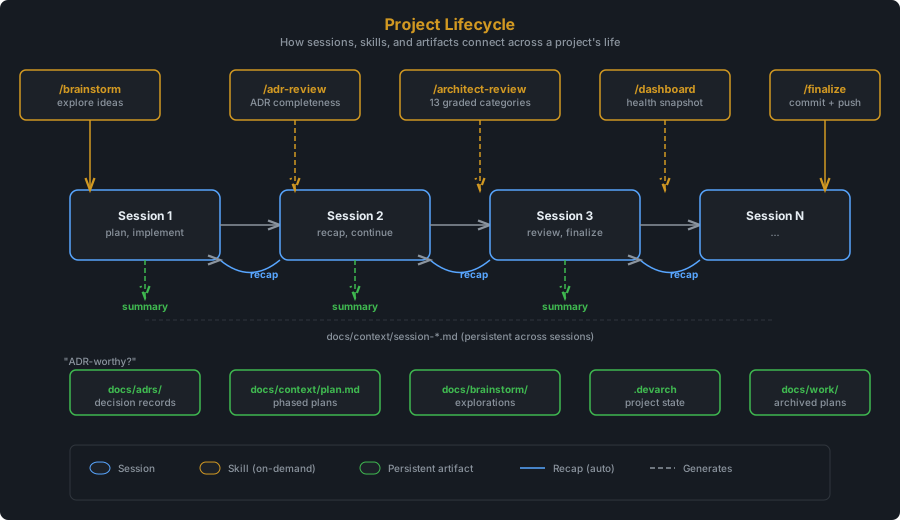
The category
This is harness engineering.
Prompt engineering got the words right. Context engineering got the information right. Harness engineering gets the environment right: the directives, agents, and feedback loops that govern how an AI writes code. DevArch is that layer for Claude Code.
Step 1
Prompt engineering
Language
Get the words right.
Step 2
Context engineering
Information
Get the inputs right.
Step 3
Harness engineering
Environment
Govern how the agent works.
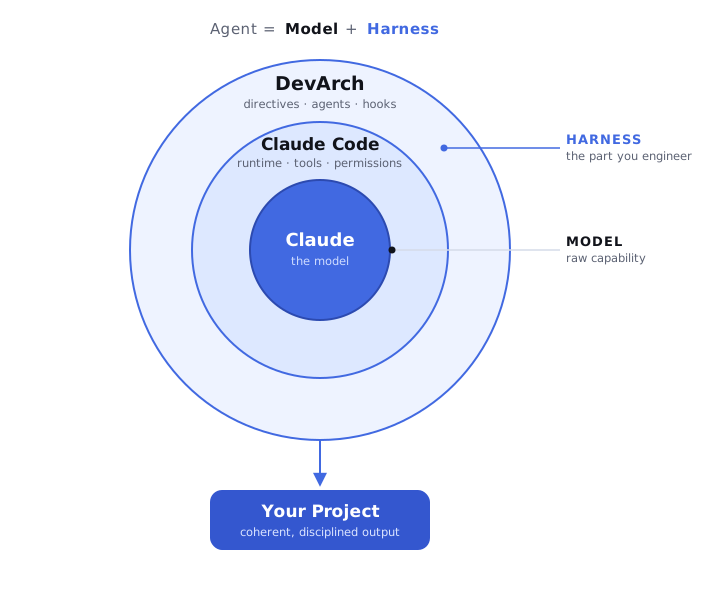
Agent = Model + Harness
The model is half the system. The harness, everything wrapping it, is the other half, and the half you control. DevArch is the outermost ring: the discipline that governs everything inside.
The industry is converging on the name. Martin Fowler, Red Hat, and Loiane Groner all call it harness engineering. DevArch has been building it since v1.0.
What's inside
Four pillars. Enforced, not suggested.
Every rule fires automatically through Claude Code's lifecycle. You direct the work; DevArch keeps the discipline.
Continuity
- Session start restores context and the last session's recap
- Work summaries capture state, blockers, and decisions
- Per-session IDs keep concurrent sessions from colliding
Coding Discipline
- Invariants and variants named before code is written
- Boundary Statements gate edits to cross-boundary state
- Cohesive modules with clear domain / infrastructure boundaries
Testing & Verification
- Behavior Statements precede every test
- Tests graded RED / YELLOW / GREEN
- Mutation checks and real-path integration tests
Architecture & Decisions
- ADRs capture decisions that constrain future work
- Planning gates decompose goals into phases
- Commands and events named for intent and outcome; silent state changes are bugs
Every pillar is built from two kinds of control: Guides that steer the agent before it acts, and Sensors that catch what it did after.
CLAUDE.md directives
Guides
Steer before the agent acts · feed-forward
Agents: mutation-verification, pre-session-audit, pattern-recurrence-detector
Sensors
Observe and self-correct · inferential
Hooks: boundary-check, budget, gates
Sensors
Deterministic checks · computational
The Guides / Sensors vocabulary is harness engineering; DevArch supplies the mechanisms.
Proof
Real sessions, no mockups.
This is what a DevArch session actually looks like: install to commit, with the gates and agents firing along the way.
$ bash devarch-install.sh && devarch init
  ✓ DevArch v8.0.0 installed · 10 agents, 19 skills, 12 hooks
$ claude
↳ SessionStart · [session a78e93]
  ✓ recap: where we left off · v8.0.0 cut
↳ pre-session-audit
  ⚠ 1 blocker: no test for the new contact route
$ implement the contact endpoint
↳ session-planner · 4 phases, plan.md written
  … writing code, behavior statements, tests …
↳ mutation-verification
  ✓ tests assert on real state changes
$ ship it
↳ work-summary-writer · commit-remote
  ✓ committed + pushed 78237f0 (41s)
Proof
DevArch evolved from itself.
The rules were forged building the thing that enforces them. Every release ships under its own discipline; the changelog is the case study.
v1.0
CLI, agents, lifecycle rules
v2.0
Boundary Statements & Integration Reality
v3.0
Tuned for Claude Opus 4.7
v4.0
A product: installer, registry, Polar purchase
v4.1
Decision-aware planning + plan-review
v4.2
Installer hardening + Unix hidden-file fixes
v4.5
Domain modeling with three entry paths + SME primer loop
v4.6
Validated for Claude Fable 5: rule-firing harness now real
v5.0
The harness spine: always-on event log + inline banners
v5.1
Team mode: per-developer session context
v5.3
Quality-weighted test coverage assessment
v6.0
The DDD facilitation surface is withdrawn
v6.1
Environment setup: helper tools + safe API keys
v7.0
Async questions: post to chat, the answer comes back
v8.0
The whole loop: charters, the beat, and Venture
v9.0
The hand-off goes declarative: a story in, a proposal out
Pricing
One product, everything included.
Annual license, priced by developers. Solo starts with a 14-day free trial, with no charge today.
New here? How does DevArch work? The fifteen-minute primer →
Solo
One Developer
$99 /yr
per year · 1 seat
All of DevArch, one seat. 14-day free trial, then $99/year.
Team
Up to 10 Developers
$4,950 /yr
per year · up to 10 developers
One license for a team of up to ten developers: shared repositories with per-developer session context, the team standup, and every gate and agent.
Enterprise
Your Organization
Custom /yr
per organization
More than 10 developers, invoicing, custom terms, and priority support. Priced per organization, through conversation.
Every license includes everything; nothing is gated, and nothing phones home. More than 10 developers, invoicing, or custom terms? Get in touch.
Questions
Before you start.
Does DevArch work with my existing CI/CD and editor?+
Yes. DevArch is a layer for Claude Code: directives, agents, hooks, and skills. It doesn't replace your build, test, or deploy tooling; it enforces discipline around the work, then you commit and ship through your normal pipeline.
What's included in each tier?+
Everything. There is one product: all agents, skills, hooks, and capabilities are in every license. Licenses differ only by how many people they cover.
What happens when my license lapses?+
DevArch is an annual license. Your projects and their artifacts (summaries, ADRs, plans) are plain files in your repo and stay yours. Continued use of the methodology tooling requires an active license.
Is my code or data sent anywhere?+
DevArch runs locally inside Claude Code. It reads and writes files in your repo; it doesn't add a server or send your code to DevArch. There is no license check of any kind: no tokens, no phone-home, no telemetry.
Which Claude models does it target?+
DevArch is tuned and validated for the latest Claude models (currently Opus 4.8), and rule-firing is re-validated on every model bump and on every new model line.
How do I install it after buying?+
Purchase through Polar checkout and you receive the self-contained installer. One command installs to ~/.devarch and puts devarch on your PATH, with no git clone and no dependencies. Your plain-language license terms land alongside as LICENSE.md; nothing reads or verifies it.
Bring discipline to your Claude Code.
Start free for 14 days. Keep your summaries, ADRs, and plans whether you stay or not.